

If you’re traveling on the Shinkansen with a suitcase, there’s one number you really need to know: 160cm. That’s the combined height, width, and depth of your luggage, and it determines whether you can simply bring your bag on board or need to reserve a seat with an oversized baggage area.
The good news is that Shinkansen luggage rules are much simpler than they first appear. Most suitcases don’t require any special reservation, and once you know the size limit, where your luggage can go, and what to do with a larger bag, the whole process is fairly straightforward.
I’ve spent enough time traveling around Japan to know that the official rules aren’t always written with first-time visitors in mind. So in this guide, I’m focusing on the things you’ll actually need to know: the 160cm luggage rule, the ¥1,000 fee for oversized luggage without the required reservation, where to store your suitcase on board, how to book the right seat, and when luggage forwarding is the easier option.
If you’re still planning the rest of your train journey, this guide is also part of my complete Shinkansen guide for first-timers.
Why this is worth sorting out before you travel
A few realities make this more than a minor detail:
- The rule is enforced, not a suggestion. On the busiest routes in the country, an oversized bag without a reservation gets you a real penalty fee and your luggage moved somewhere you didn’t choose.
- Dwell times at stations are short. Most Shinkansen stop for a minute or two at each station. Wrestling a huge suitcase down a narrow aisle while everyone waits is not a great way to start your day.
- Space on board is genuinely limited. There’s no giant cargo hold like on a plane. What doesn’t fit above your seat or at your feet needs a plan.
None of this is complicated, it just needs a few minutes of prep.
The rule that catches people out: the 160cm limit
On the Tokaido, Sanyo, Kyushu, and Nishi-Kyushu (West Kyushu) Shinkansen, any piece of luggage with total dimensions (height + width + depth, including wheels and handles) of 160cm or more requires you to reserve a seat with a designated oversized baggage area. This is a real measurement, not a rough guess, so it’s worth actually adding up your bag’s three dimensions before you travel. A large hardshell suitcase, especially one around 75cm tall, can hit that number faster than people expect once wheels are counted in.
Here’s how it breaks down:
- Under 160cm: No reservation needed. Store it in the overhead rack or at your feet like normal.
- 160cm to 250cm: You must reserve a “seat with oversized baggage area” in advance. This reservation is free, it’s just a specific seat category you need to select when booking.
- Over 250cm: Not permitted on board at all. At that size, you need to ship it ahead instead (more on that below).
There’s also a general weight cap of 30kg per bag, worth knowing if you’re traveling with anything unusually heavy.
If you show up with an oversized bag and no reservation, you’ll be charged a ¥1,000 handling fee. You’ll then need to follow the train crew’s instructions about where to store the luggage, rather than simply using the oversized baggage space yourself. During busy periods, there may not be space at all, which is its own kind of stressful.
A few notable exceptions: strollers, musical instruments, and disassembled bicycles in proper travel bags are technically exempt from the oversized rule even if they measure over 160cm. That said, if you’re traveling with something like a cello, I’d still book the oversized seat anyway. Squeezing a large instrument case into normal legroom is uncomfortable for you and whoever’s sitting next to you.
Where your luggage actually goes on board
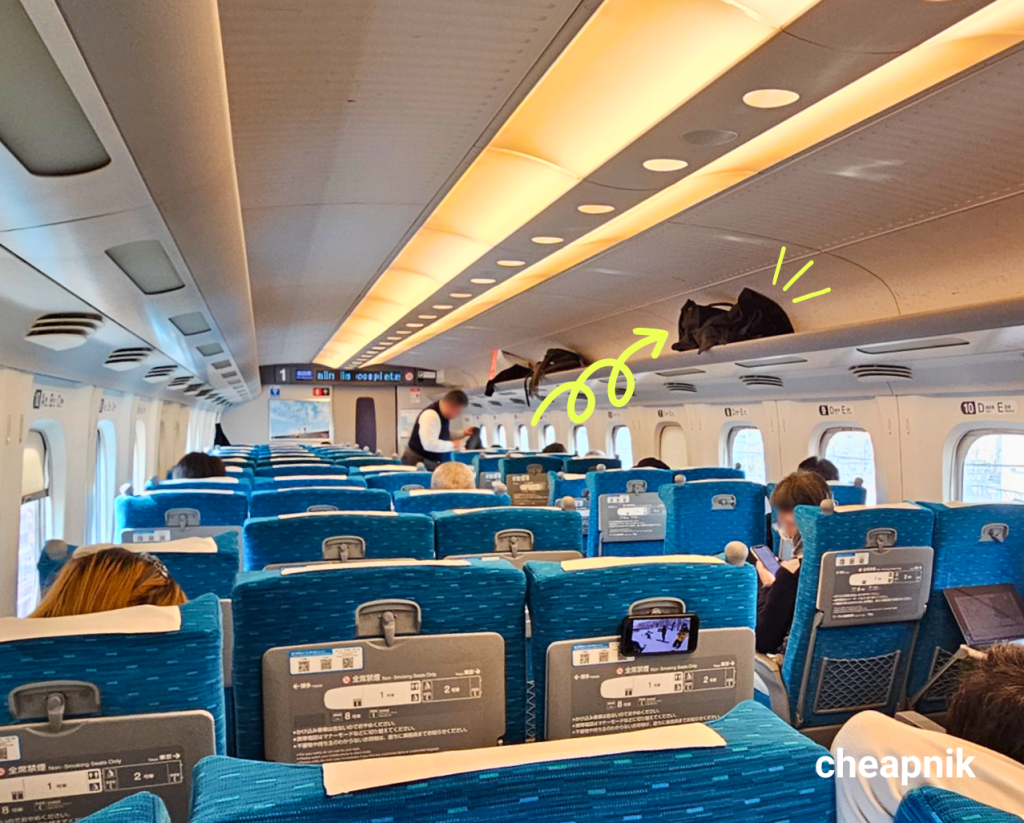
For most travelers with a standard suitcase, there are two spots:
- The overhead rack, fine for a carry-on or smaller case.
- The space beside or in front of your seat, where most standard-size suitcases end up, since the overhead racks aren’t deep enough for larger bags.
If you’ve booked an oversized baggage seat, your bag goes into the dedicated oversized luggage area located behind the last row of seats in the car. This is the whole reason the reservation system exists, it gives you access to the designated oversized-baggage space back there when you board.
How to book the oversized baggage seat
This isn’t a separate purchase, it’s a seat category you select at the same time as your regular ticket:
- Online, through SmartEX or your booking platform of choice (full comparison of these in my guide to buying Shinkansen tickets), by selecting a “seat with oversized baggage area” instead of a standard reserved seat.
- At a station, through a ticket machine or staffed counter (Midori-no-madoguchi), which is often the easiest route if you want a person to double check you’re getting the right seat category.
Because there are a limited number of these seats per train, they can sell out during busy periods like Golden Week or Obon. If you know in advance you’re traveling with something oversized, book it as early as you reasonably can rather than assuming you’ll sort it out at the station.
When it’s smarter to not carry the bag at all
Honestly, a lot of experienced Japan travelers sidestep this whole issue by not bringing the big suitcase onto the train in the first place. Two tools make that realistic:
Coin lockers, for same-day storage. If you’re passing through a city for a few hours before continuing on, station lockers let you stash a bag temporarily rather than hauling it around or trying to bring it on board for a short leg.
Luggage forwarding (takkyubin), for moving between cities. This is Japan’s nationwide courier network, most commonly run by Yamato Transport, and it’s genuinely one of the more useful travel hacks in the country. You drop your suitcase at your hotel’s front desk (or a convenience store, or an airport counter) in the morning, and it’s typically delivered to your next hotel by the following day. Pricing generally runs somewhere in the ¥2,000 to ¥3,700 range per bag depending on size and distance, and most hotels handle the paperwork for you at the desk. You keep a small daypack with what you need for that day and ride the Shinkansen completely unencumbered. Check out my blog post on luggage deliveries in Japan for more info on each available option.
The tradeoff is timing: this is next-day delivery in most cases, not instant, so it works best when you’re not planning to need anything from that suitcase the same evening you ship it. Keep your travel documents, medications, and valuables with you regardless, since forwarding services aren’t designed for anything you might need on short notice, and compensation limits apply if something goes wrong with a shipped bag.
Which approach actually fits your trip
- One suitcase, one city-hopping route, standard size: Just bring it on board. No reservation needed under 160cm.
- One large suitcase, 160cm or more: Book the oversized baggage seat when you book your ticket. It’s free, it just needs to be selected.
- Multiple cities, want to travel light on transit days: Ship your bag ahead via takkyubin and carry a daypack instead.
- Quick stopover before continuing on the same day: Use a station coin locker rather than dragging the bag onto a train for a short leg.
- A stroller, instrument, or bike in a travel bag: Technically exempt from the size rule, but book the oversized seat anyway if it’s genuinely large.
The bottom line
The Shinkansen luggage rules aren’t complicated, there’s really just one number to remember: 160cm. Under that, you don’t need to think about it. Over it, book the oversized seat when you book your ticket, and it costs nothing extra. And if you’d rather not deal with any of it, Japan’s luggage forwarding network makes traveling hands-free a completely realistic option, not just a luxury. Plan around whichever of these fits your itinerary, and the platform scramble I mentioned at the start just doesn’t happen to you.
With your luggage plan sorted, the next question is usually how to actually find your car and get it stowed without holding up the line. My Shinkansen boarding and platform guide walks through exactly that.
Luggage rules and other details may change. Confirm current rules before travel, especially if you’re planning around a specific oversized reservation.


