
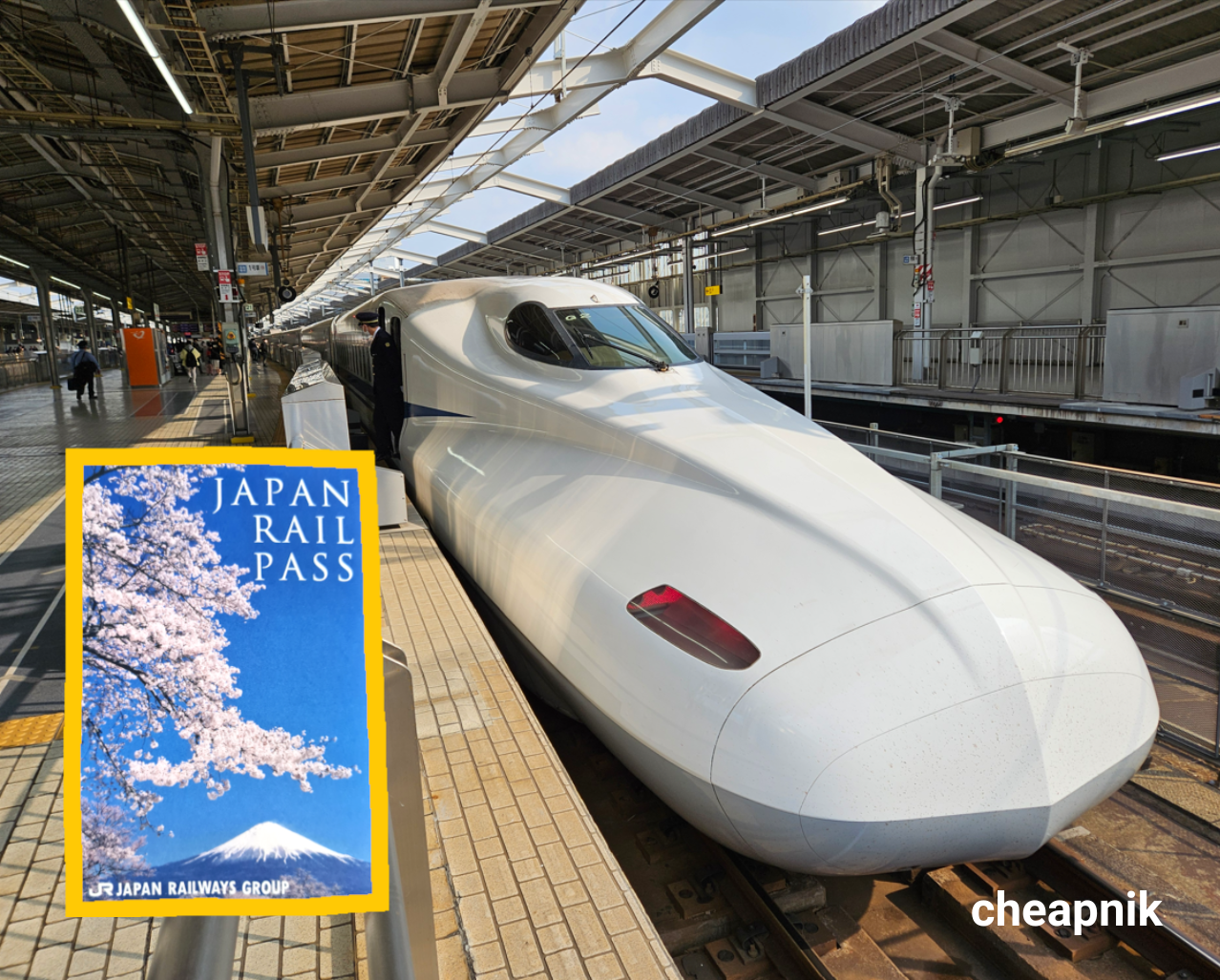
Last updated: August 1, 2026
TL;DR: The Nationwide JR Pass costs ¥50,000 for 7 days (Ordinary Car, adult) as of this update — up ~70% since October 2023. It’s still worth it if you’re covering serious ground (think Tokyo → Kyoto → Hiroshima → Fukuoka), but it usually doesn’t pay off for a simple Tokyo-Kyoto-Osaka trip anymore, since that route now costs less in individual tickets. Keep reading for the full math, or jump straight to the pricing table or FAQ.
If you’re still figuring out how Shinkansen travel works in Japan, check out my complete Shinkansen guide for first-timers to get the bigger picture.
Table of Contents:
- What is a JR Pass?
- Is the JR Pass Still Worth Buying in 2026?
- Nationwide vs. Regional Pass — Which Should You Get?
- Conditions of JR Pass
- Who is eligible to purchase a JR Pass?
- How to buy a JR Pass in three steps
- How to use the JR Pass (practical tips)
- FAQ
Planning that long-desired (not to mention expensive) trip to Japan and wondering if the JR Pass is worth it? Good question to ask — because these days, it’s not the automatic money-saver it used to be. Keeping commuting costs down by grabbing a JR Pass used to be a no-brainer; now, it’s more of a math problem, and I’ll walk you through exactly how to do that math for your specific trip.
There’s a wealth of information out there on the JR Pass, and honestly, a lot of it lists prices and rules that haven’t been accurate in years — not helpful when you’re trying to figure out if you’ll actually save money, on top of untangling Japanese terms and complex train maps.
Trust me, I’ve been down this rabbit hole myself. This is the reason I wrote (and keep updating) this guide — to help you make sense of all this information, skip the overload, and know exactly what you’re getting into before you buy, so you don’t get lost on your next trip to Japan.
IMPORTANT! If you only plan to stay within Tokyo and you wish to be able to go around the city using an unlimited pass, consider getting the Tokyo Subway Ticket instead as it’s way cheaper than the JR Pass (but only limited to Tokyo). Check out my Tokyo Subway Ticket guide for more info. 😉
What is a Japan Rail Pass (JR Pass)?
So what exactly is the JR Pass, and how does it work? The Japan Rail Pass (ジャパンレールパス japan rēru pasu), also called the JR Pass, is your golden ticket to Japan for when you want to explore much of the country in a little time, and — when your itinerary is the right shape for it — save on transportation costs on the bullet train or shinkansen (which are dang expensive) and some local lines.
Think of it as a prepaid ticket that gets you unlimited travel on all major (with a few exceptions) Japan Railways (JR) trains for a set number of days. With a JR Pass, you can hop on any JR train, including the shinkansen, without buying individual tickets for each journey.
Using it is refreshingly simple: just show your pass (or scan it, depending on the station) at the JR ticket gate and hop on board.
One catch worth knowing upfront: because the JR Pass is designed specifically to stimulate tourism, it’s only available for purchase by foreign tourists. And these days, you can no longer buy it at ticket counters inside Japan — so you can only buy the JR Pass from outside Japan, either online or through an authorized travel agent before you fly.
Is the JR Pass Still Worth Buying in 2026?
Okay, real talk — this used to be an easy yes. Not anymore.
Back in the day, the JR Pass was a no-brainer money saver. But in October 2023, JR raised the price of the nationwide pass by roughly 65–70% across the board, and it changed the whole calculation. So before you click “buy,” let’s actually do the math together.
Here’s the number that actually matters: a round-trip Tokyo–Kyoto Shinkansen ticket costs around ¥28,000 — well under the current ¥50,000 pass price. That means a single-region trip (just Tokyo and Kyoto, say) almost never breaks even anymore.
Where the pass does still pay off is multi-region trips that cover serious ground — something like Tokyo → Kyoto → Hiroshima → Fukuoka → back to Tokyo. An itinerary like that can run ¥57,000+ in individual tickets, so a 7-day pass would save you money and give you unlimited rides on top of it.
My rule of thumb:
- Get the pass if: you’re doing a genuine multi-region loop (e.g., Tokyo-Kansai-Hiroshima-Kyushu), or you value not having to book/pay for every single leg.
- Skip the pass if: your itinerary is basically the “Golden Route” (eg. Tokyo-to-Kyoto or Tokyo-to-Osaka) and not much further — buy individual Shinkansen tickets instead and you’ll come out ahead.
- Do the math if: you’re not sure – add up what each planned JR leg would cost individually, and compare that total to the pass price for your trip length.
*If you choose to skip the pass and just buy individual tickets, check out my blog post on how to buy shinkansen tickets to see all your options and the comparison for each.
Heads up: JR announced in April 2026 that prices are rising again from October 1, 2026, but only for passes bought through overseas travel agencies (the 7-day Ordinary pass moves from ¥50,000 to ¥53,000). As of this writing, the official JR Pass site has said it’s holding current prices for a limited time, though it hasn’t announced an end date. If your trip lines up near that window, buying early could save you a bit.
Read more: Are you just staying in Tokyo and need an efficient train service to and from Narita Airport? Check out my blog post on the Narita Express, a train service from Japan Rail (JR) that gets you from the airport to downtown Tokyo and back.
Nationwide vs. Regional Pass: Which Should You Get?
Since the 2023 price hike, regional passes have become a much more attractive option for a lot of trips so don’t just default to the nationwide pass without checking these first. Below is a just some examples of the regional pass – check out my JR Regional Passes guide to see the fuller picture and see what’s right for you.
| Pass | Duration | Adult Price | Best For |
|---|---|---|---|
| Nationwide JR Pass | 7 / 14 / 21 days | ¥50,000 / ¥80,000 / ¥100,000 | Multi-region trips covering serious distance (Tokyo-Kansai-Kyushu, etc.) |
| JR Kansai Wide Area Pass | 5 days | ¥12,000 | Osaka/Kyoto base with side trips to Okayama, Kinosaki Onsen, Wakayama, or Takamatsu |
| JR Tokyo Wide Pass | 3 days | ¥16,000 (effective March 14, 2026) | Tokyo base with day trips to Nikko, Mt. Fuji/Kawaguchiko area, Izu, or Gala Yuzawa |
These are just two regional examples to show the pattern – there are regional passes for Hokkaido, Kyushu, Tohoku, and more, each with their own coverage area and price. If your trip is centered on one region, it’s worth checking whether a regional pass beats the nationwide one for your specific route.
Check current prices and buy: Nationwide JR Pass on Klook | JRPass.com | Japan Experience
You can choose your JR Pass based on which car or seat class of the Shinkansen train you want to ride on, one for each class of service:
- The Standard / Ordinary Car (普通車 Futsūsha) – it’s the usual train car, still spacious and so clean and gets you to where you want to go. Of course this is the one I use since it’s the least expensive option, and I’ve no qualms about it. It’s so quiet and comfortable inside, with its own snack service (buy as you wish) and of course, clean toilets.

- Green Car (グリーン車 Gurīnsha) – it’s the first class car, where there is less crowd and more space for you. They will also serve you refreshments only on selected routes. For me, it is not advisable to get a Green Car pass since it is more expensive and I’m not sure if the train routes I’ll be using will serve refreshments. Plus, less space is not an issue for me as you still get your own generous space in the standard car.

Conditions of JR Pass
Before you get too excited about unlimited train travel, there are a few conditions and rules worth knowing. First and biggest: you have to buy the JR Pass before you arrive in Japan, either online or through an authorized agent (aka your trusted travel agency). There’s no walking into a station and picking one up on a whim.
Once purchased, you’ll receive an Exchange Order that you’ll trade in for the actual pass at a JR station in Japan. Once activated, your pass is good for the duration you chose, and you can reserve seats on most trains for free. Just note that some trains require an extra fee or reservation – including the two fastest Shinkansen classes, which I’ll cover in the practical tips section below.
Who is eligible to take advantage of the JR Pass?
Not everyone can walk up and buy a JR Pass – it’s built specifically for a couple of narrow categories of traveler. Here’s exactly who qualifies:
- Foreign tourists visiting Japan who have a passport bearing the “Temporary Visitor” entry status stamped at immigration, and who can present the actual passport at the time of exchange. A photocopy of the passport is not acceptable. If you are a foreigner in Japan but do not have “Temporary Visitor” status (say, you have a Working Visa or Permanent Resident status), sorry but you cannot obtain a JR Pass.
- A Japanese national living in a foreign country,
- who is qualified to live permanently in that foreign country, or
- who is married to a non-Japanese residing in a country other than Japan.
One thing worth knowing: if you enter Japan through an automated immigration gate at the airport, you won’t get a physical “Temporary Visitor” stamp or sticker in your passport. If you plan on getting a JR Pass, make sure to use a staffed immigration lane (or ask a clerk to add the stamp) instead of the automated gate, or you may not be able to prove your eligibility when you go to exchange your pass.
How and Where to Get a JR Pass
To simplify things and save you the headache, there are three main steps to get a JR Pass:
STEP #1. Buy a JR Pass + Current Pricing
You can buy a JR Pass from a trusted travel agency, the official JR Pass website, or through authorized online resellers:
- Buy JR Pass from a local travel agency – Better as you will get a personalized service, and you can easily contact them if you have concerns with your pass. You will also get your Exchange Order instantly instead of having to wait for it to arrive by mail.
- Buy JR Pass online – You can buy directly from the official JR Pass website or through authorized resellers like Klook, JRPass.com, or Japan Experience. Once purchased online, they will ship you your Exchange Order via a courier service, or in some cases issue you an electronic reservation number instead. Some providers charge a shipping fee that gets added at checkout, though some offer free shipping.
Nationwide JR Pass Pricing (2026)
| Duration | Ordinary Car (Adult) | Ordinary Car (Child 6-11) |
|---|---|---|
| 7-Day | ¥50,000 | ¥25,000 |
| 14-Day | ¥80,000 | ¥40,000 |
| 21-Day | ¥100,000 | ¥50,000 |
Note: Prices reflect the current official JR Group rate as of this update, rising to ¥53,000 / ¥84,000 / ¥105,000 (Ordinary, overseas agents) from October 1, 2026. Reseller prices (Klook, JRPass.com, Japan Experience) can vary slightly and change independently. Click through below to check the live price before booking, since I’m not listing a fixed per-reseller number here that could go stale.
👉 Check live prices: Klook | JRPass.com | Japan Experience
After paying for your JR Pass, what you will receive is an Exchange Order, which we’ll talk about in Step #2 below.
STEP #2. Receive your Exchange Order
What’s the difference between a JR Pass and an “Exchange Order,” you ask? Well, the Exchange Order is what you’ll receive when you buy a JR Pass in Step #1 above, while the JR Pass is the actual physical pass that you use at the train stations.
It may be a bit confusing, like why not just give you the JR Pass directly, right? This is because you’ll use your Exchange Order (received outside of Japan) as proof of payment in order to get your actual JR Pass at a JR Ticket Office once you’re in Japan.
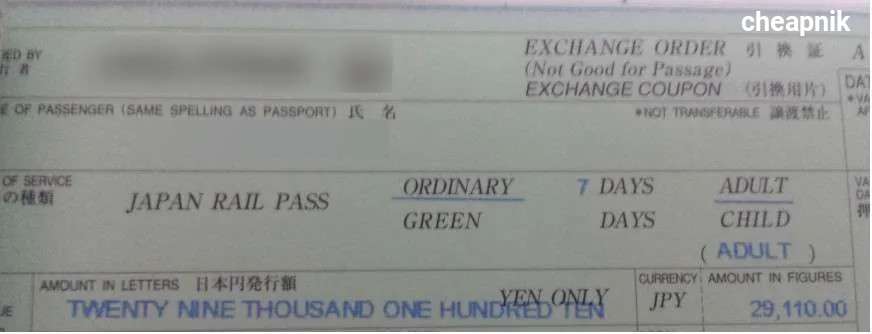
Note: Always make sure that your name is correctly spelled on the Exchange Order and matches the name on your passport.
Remember, you cannot buy a JR Pass inside Japan (only from outside the country), so your Exchange Order is proof that you paid for it while you were still abroad.
After receiving your Exchange Order, you generally have 90 days from the voucher’s confirmation date to redeem your JR Pass in Japan — though this window can vary slightly by provider, so double-check the exact terms with whoever you bought from. Now on to Step #3 below.
STEP #3. Redeem and Activate your JR Pass
Once you have arrived in Japan, proceed to the nearest JR Ticket Office to redeem your JR Pass.
JR Ticket Offices are usually at major train stations in airports or at the city center, so you’re not likely to miss them while searching for one at the airport train station.

When redeeming your JR Pass, note that you don’t have to activate it right away – you have the option to choose an activation date within 30 days from the date you redeem your JR Pass at the Ticket Office. (Remember, your JR Pass comes in 7, 14, or 21 days of validity for the nationwide pass, and the clock starts ticking once you activate it.)
Once activated, you can use your pass normally at the station gates. Many stations now use automatic ticket gates where you insert or tap your pass, rather than the manned-gate presentation that used to be the norm – though staffed gates are still around too, especially for larger passes or unusual cases.
One other important thing to note: If you activate your JR Pass at, say, 11:30 PM on a given day, the remaining 30 minutes will already count as an entire day used against your JR Pass.
How to Use the JR Pass (and some practical tips)
This is the part most people find frustrating due to the sheer amount of info out there, so let me simplify it for you.
- First thing you need to do when you arrive in Japan is to get your actual JR Pass by presenting your Exchange Order and passport (with the “Temporary Visitor” stamp) at the nearest JR Ticket Office — usually in the main station of the airport you’re arriving at. The Exchange Order itself cannot be used for travel and must be exchanged at a JR Ticket Office.
- For lengthy distances (e.g., Tokyo–Osaka round trip), use the Shinkansen (Bullet Train). Your JR Pass is valid on the Kodama (stops at all stations) and Hikari/Sakura (stops at main stations only) types of Shinkansen. These days, you can also ride the Nozomi and Mizuho classes (the fastest, stopping only at very large cities) — but you’ll need to pay an extra supplement fee to do so (for example, around ¥4,960 for the Tokyo–Kyoto route). Check out my blog post on the difference between Nozomi vs Hikari vs Kodama for the lowdown.
- In practice, Hikari and Sakura trains reach the same top speed as Nozomi and Mizuho and use the same type of train — they just make more stops. For the Tokyo–Kyoto route specifically, Hikari runs only about 15 minutes slower than Nozomi. My take: unless you’re really pressed for time, save the yen and stick with Hikari/Sakura, which are fully covered by your pass with no extra fee.
- Planning your routes: If you’ve read older guides (including older versions of this one 😅), you’ve probably seen Hyperdia recommended as the tool for planning JR routes. That’s no longer good advice – Hyperdia effectively shut down its detailed timetable and route-search service back in April 2022, and no longer shows exact departure times or lets you filter out Nozomi trains. Here’s what to use instead:
- First check out my Shinkansen Lines Guide to see all the ten lines, where they go, and what the popular stops are, to easily get the big picture.
- Japan Travel by NAVITIME (top pick) – Free app with a JR Pass filter that shows only pass-covered routes. Available on iOS and Android.
- Jorudan (Japan Transit Planner) – A free app/website that’s been around almost as long as Hyperdia, available in 13 languages, also with a JR Pass filter.
- Google Maps – Not JR Pass-aware, but reliable for schedules, platforms, and transfers, and covers walking/bus/train routes together.My honest recommendation: use Navitime or Jorudan to confirm a route is JR Pass-eligible, then cross-check timing on Google Maps if you want a second opinion. All of these need an internet connection, so you’ll still want pocket WiFi or an eSIM for the duration of your trip – check out my eSIM/SIM/Pocket WiFi guide for that.
My tips to ensure the smoothest travel possible across Japan
- Using your smartphone with the Google Maps app, download the map of a specific city so you can go offline and use GPS to locate yourself.
- Don’t be afraid to ask locals and foreigners alike. Japan is a relatively safe country. Most station staff know enough English to give you directions. Outside the stations, students are often a good bet since many study English.
- Plan ahead. Especially in a non-English-speaking country, plan your routes weeks beforehand to save time and money. Doesn’t it feel good to feel like you’ve already lived in a city because you did your research? Researching weeks before travel adds to the excitement, and to me, is part of the experience.
Frequently Asked Questions
Is the JR Pass still worth it in 2026?
It depends on your itinerary. If you’re doing a multi-region trip covering serious distance (e.g., Tokyo-Kyoto-Hiroshima-Fukuoka), yes. If you’re sticking to Tokyo-Kyoto-Osaka, individual tickets are usually cheaper since the 2023 price increase. See the full breakdown above, and if you choose to just buy individual tickets, check out my blog post on how to buy shinkansen tickets.
Can I buy a JR Pass inside Japan?
No. You can only buy it from outside Japan, online or through an authorized travel agent, before you fly.
Can I use the JR Pass on the Nozomi or Mizuho bullet trains?
Yes, but you’ll need to pay an extra supplement fee on top of your pass (around ¥4,960 for a Tokyo-Kyoto trip, for example). The Hikari and Sakura trains remain fully covered with no extra fee and are only marginally slower.
How long do I have to redeem my Exchange Order?
Generally 90 days from the voucher’s confirmation date, though this can vary slightly by provider – confirm with whoever you bought your pass from.
JR Pass vs. Suica/Pasmo: Do I need both?
They serve different purposes. The JR Pass covers unlimited long-distance JR travel (including the Shinkansen) for a set number of days. A Suica or Pasmo IC card is for everyday local transport — subways, buses, and non-JR lines — and works whether or not you have a JR Pass. Most travelers doing intercity trips end up wanting both. Check out my Welcome Suica and Pasmo Passport guide for details.
Details provided here can change at any time, so please double check prices, routes, and steps to buy before getting a JR Pass.
Do you have any questions, or any tips to share on getting a JR Pass? Feel free to comment down below! 🙂


