

The Shinkansen is one of Japan’s greatest travel inventions – but planning your first bullet train journey can feel surprisingly confusing. Nozomi, Hikari, Kodama, Hayabusa, Tsubame… then there are ten routes, different service types, and JR Pass rules to understand.
The good news is that you don’t need to memorize Japan’s entire rail map. This guide explains every Shinkansen line, where it goes, and how the train naming system actually works. (If you want the full step-by-step trip-planning walkthrough this fits into, my complete Shinkansen guide for first-timers covers everything from here through booking, boarding, and what to eat on board.)
TL;DR
- The Shinkansen network has ten lines, run by five JR companies, splitting into a southern spine (Tokyo to Kyushu), a northern spine (Tokyo to Hokkaido), inland/coastal routes toward the Sea of Japan, and two “mini-Shinkansen” branch lines.
- Train names differ by line. Nozomi/Hikari/Kodama only apply to the Tokaido and Sanyo lines, other lines use their own naming (Mizuho, Hayabusa, Kagayaki, and so on).
- The nationwide JR Pass doesn’t cover Nozomi or Mizuho, the two fastest services on the southern spine, by default. You can still ride them by paying a supplementary ticket, otherwise Hikari and Sakura are fully covered.
- There’s no Shinkansen to Shikoku or Okinawa, plan around that if either is on your list.
Why bother learning this at all
You can absolutely show up in Japan and figure it out as you go. People do it every day. But here’s the thing: the Shinkansen isn’t one train system, it’s ten separate lines run by different JR companies, and they don’t all behave the same way.
Knowing the layout before you land means you can:
- Build an itinerary that actually makes geographic sense instead of zigzagging across the country
- Know in advance whether the JR Pass is worth buying for your trip, or whether it’ll lose you money
- Avoid accidentally boarding a train your pass doesn’t cover / will require a supplementary ticket (this happens constantly with Nozomi and Mizuho)
- Spot the regions most tourists skip because they don’t realize a bullet train goes there
Basically, five minutes with this guide saves you from expensive guesswork later.
What the Shinkansen actually is, real quick
Japan’s bullet train network has been running since October 1, 1964, starting with the Tokaido line between Tokyo and Osaka. Since then it’s expanded into ten distinct lines covering Honshu, Kyushu, and Hokkaido, with top speeds around 320 km/h depending on the line and train model.
The safety record is genuinely wild: since that first train in 1964, the network has carried well over 10 billion passengers without a single passenger fatality caused by a train accident. No other high-speed rail system in the world comes close to matching that.
The lines are split between two different electrical systems (50 Hz in the east, 60 Hz in the west), which is a fun technical detail but doesn’t affect you as a rider. What does affect you is which company operates which line, because that determines which passes work where.
The ten Shinkansen lines, grouped by direction
Rather than memorizing ten names in isolation, it helps to think of the network in three groups radiating out from Tokyo.
The southern spine: Tokyo to Kyushu
This is the route almost every first-time visitor uses, and it’s the busiest high-speed rail corridor on earth.
- Tokaido Shinkansen: Tokyo to Shin-Osaka, running through Nagoya and Kyoto. This is the workhorse line, carrying hundreds of thousands of passengers a day.
- Sanyo Shinkansen: Continues from Shin-Osaka through Okayama, Hiroshima, and down to Hakata (Fukuoka), tracing the Seto Inland Sea coastline.
- Kyushu Shinkansen: Picks up from Hakata and runs south through Kumamoto to Kagoshima-Chuo, opening up the island of Kyushu.
- West Kyushu Shinkansen: A newer, shorter line connecting Takeo-Onsen to Nagasaki, useful if Nagasaki is on your list.
Ride all four back to back and you can technically go from Tokyo to Kagoshima almost entirely by bullet train.
The northern spine: Tokyo up to Aomori and Hokkaido
The Hayabusa, the fastest service on this half of the network, runs straight through from Tokyo to Shin-Hakodate-Hokuto without a change, crossing from Honshu to Hokkaido beneath the Tsugaru Strait in the same seat you started in.
- Tohoku Shinkansen: Tokyo north through Sendai and Morioka to Shin-Aomori. The fastest service here, the Hayabusa, covers the roughly 675 km to Shin-Aomori in about 3 hours.
- Hokkaido Shinkansen: Continues from Shin-Aomori under the Tsugaru Strait to Shin-Hakodate-Hokuto, your gateway to Hokkaido. One honest caveat if Sapporo is the actual goal: the Shinkansen doesn’t reach it yet. The extension from Shin-Hakodate-Hokuto to Sapporo has been repeatedly delayed by difficult tunnel geology and is now targeting a fiscal 2038 opening, more than a decade later than originally planned. Until then, getting to Sapporo means the Shinkansen to Shin-Hakodate-Hokuto followed by a limited express or flight for the rest of the way.
The inland/coastal routes: Tokyo toward the Sea of Japan
- Joetsu Shinkansen: Tokyo up to Niigata, cutting through the mountains.
- Hokuriku Shinkansen: Tokyo through Nagano and Toyama to Kanazawa, extended since March 2024 all the way to Tsuruga in Fukui Prefecture. This is genuinely one of the most underrated routes for scenery and access to traditional towns, and most tourists never touch it.
The Mini Shinkansen: Akita and Yamagata
These two are a bit different. Rather than dedicated high-speed track the whole way, they’re former conventional railway lines converted to standard gauge, allowing specially designed Shinkansen trains to run directly from Tokyo into regional cities.
- Yamagata Shinkansen: Branches off the Tohoku line at Fukushima, heading to Yamagata and Shinjo.
- Akita Shinkansen: Branches off at Morioka, heading to Akita.
They’re slower than the main lines once they leave the shared track, but they’re the easiest way to reach regional cities that act as gateways to hot spring towns and ski areas in that part of the country.
Understanding train types (this is where some confusion happens)
The line name and the train name are two different things. Every line runs a handful of different train categories, and which one you’re on determines how many stops you make, how fast you get there, and, in a few cases, whether your JR Pass even covers it. The pattern is consistent across the network: the fewer stops, the faster and more premium the train name.
The corridor most travelers actually ride is the Tokaido and Sanyo line, so it’s worth knowing that one in detail:
- Nozomi: The fastest, fewest stops. Tokyo to Shin-Osaka in about 2 hours 30 minutes.
- Hikari: Stops at more stations, roughly 20 to 45 minutes slower than Nozomi depending on the exact route.
- Kodama: Stops at every station on the line, the local of the bunch.
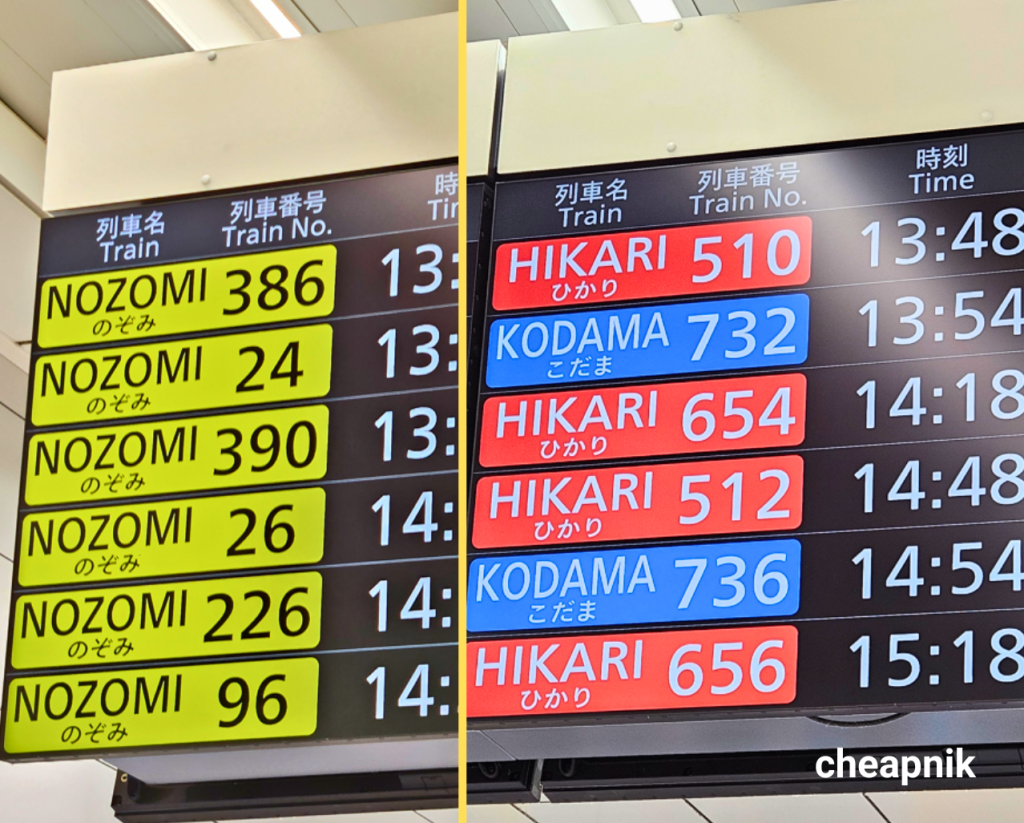
Nozomi, Hikari, and Kodama services also operate on the Sanyo Shinkansen, with some continuing as far as Hakata. Most other lines follow the same fast/medium/local pattern, just with its own set of names:
- Kyushu Shinkansen (Hakata to Kagoshima): Mizuho (fastest), Sakura, and Tsubame (local)
- Tohoku Shinkansen: Hayabusa (fastest), Yamabiko (more stops), and Nasuno (local). Hayate services are now limited
- Hokuriku Shinkansen: Kagayaki (fastest), Hakutaka, Tsurugi (a shorter Toyama-Tsuruga shuttle), and Asama (local, mostly Tokyo-Nagano)
- Joetsu Shinkansen: Toki (faster) and Tanigawa (local)
The reason the Tokaido/Sanyo naming matters more than the rest is that it affects how you use the nationwide JR Pass. Nozomi and Mizuho aren’t included as standard, but JR Pass holders can still ride them by purchasing a supplementary ticket. If you’d rather avoid paying extra, simply use Hikari or Sakura services instead. They’re only a little slower on most routes and are fully covered by the pass. I’ve gone deep on exactly how Nozomi, Hikari, and Kodama compare – speed, price, and a peak-season rule that catches a lot of travelers out, in my Nozomi vs Hikari vs Kodama guide.
What the Shinkansen doesn’t cover
Worth knowing before you plan: there’s no Shinkansen service to Shikoku or Okinawa. If those are on your itinerary, you’re looking at limited express trains, ferries, or a short flight instead. It’s an easy thing to overlook when you’re staring at a rail map that looks like it covers everything.
The JR Pass, in brief
I’ve written a full breakdown of current pricing and whether it’s worth buying for your specific route over on my JR Pass guide, so I won’t repeat all the numbers here. The short version for this post: the nationwide JR Pass gives you unlimited rides on JR lines and almost every Shinkansen service for a set number of consecutive days. Nozomi and Mizuho require a supplementary ticket if you want to use them, while other Shinkansen services are included as normal. Whether the pass saves you money depends entirely on how much ground you’re covering and how quickly.
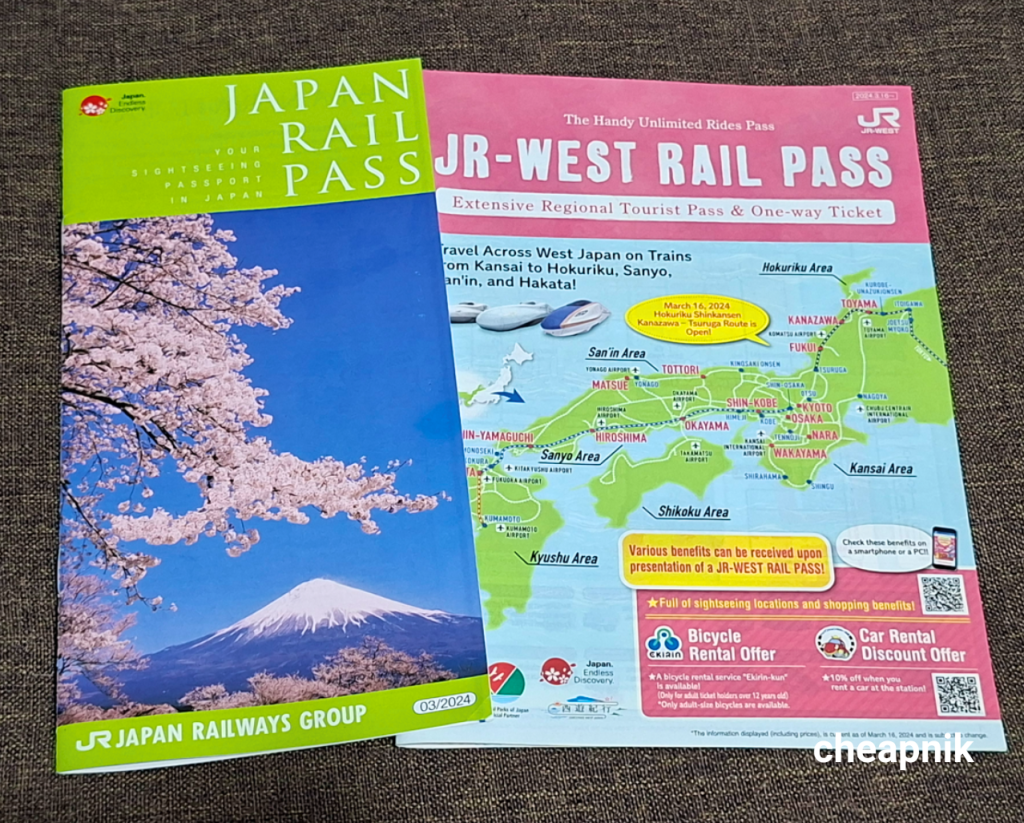
If your trip stays within one region, a JR regional pass is often the smarter buy. JR West alone sells several, covering everything from a short Kansai-only pass up to wider options that stretch to Hiroshima or into northern Kyushu, and every other region of the country has its own equivalents too. These regional passes are usually cheaper and, in some cases, even cover the Nozomi and Mizuho trains within their zone, which the nationwide pass doesn’t. I’ve mapped out every region’s options in my JR regional passes guide, worth checking against your actual route before you default to the nationwide option.
Putting it into practice
If you’re building a first-timer route, the classic move is Tokyo to Kyoto to Osaka along the Tokaido line, which is well-trodden for good reason: it’s fast, frequent, and hits the country’s biggest highlights. But once you know the network extends a lot further than that “golden route,” it opens up options:
- Add Hiroshima and Miyajima by continuing on the Sanyo line
- Detour into Kanazawa via the Hokuriku line for a quieter, more traditional stop
- Push down into Kyushu for onsen towns and Kagoshima if you have the time
- Head north to Sendai or even Hokkaido if snow, skiing, or seafood are the goal
None of this requires memorizing a timetable. It just requires knowing which line goes where, so you’re picking a route on purpose instead of guessing.
The Shinkansen looks intimidating because it’s presented as one giant system, when really it’s ten lines, a handful of train types per line, and a pass system that only rewards you if you understand how the pieces fit together. Once the layout clicks, planning a Japan trip by rail gets a lot easier, and a lot cheaper.
Once you’ve got your route mapped out, the next question is usually: how do you actually get a ticket for it? My guide to buying Shinkansen tickets covers every booking option and which one fits your specific line.
Above information may change at any time. Confirm current details before booking.


